What I build
Second brain.
Every person in an organization generates context all day. Meeting notes, decisions, project updates, the reasoning behind a choice that seemed obvious at the time. Without a system to capture and connect that context, it evaporates. Six months later, nobody remembers why the pricing changed or what the last conversation with that vendor actually covered.
The problem
Knowledge evaporates.
Most teams keep context in three places: someone's head, a Slack thread that nobody will search, and a shared drive folder that nobody opens after the first week. When someone leaves, the knowledge leaves with them. When someone new joins, they spend months reconstructing context through "quick question" meetings that are never quick.
The cost is invisible until it is not. A decision gets reversed because nobody remembered why it was made. A client relationship resets because the person who managed it moved on. A status meeting runs 45 minutes because half the room is being caught up on what the other half already knows.
What it looks like
A vault with 400 notes and zero orphans.
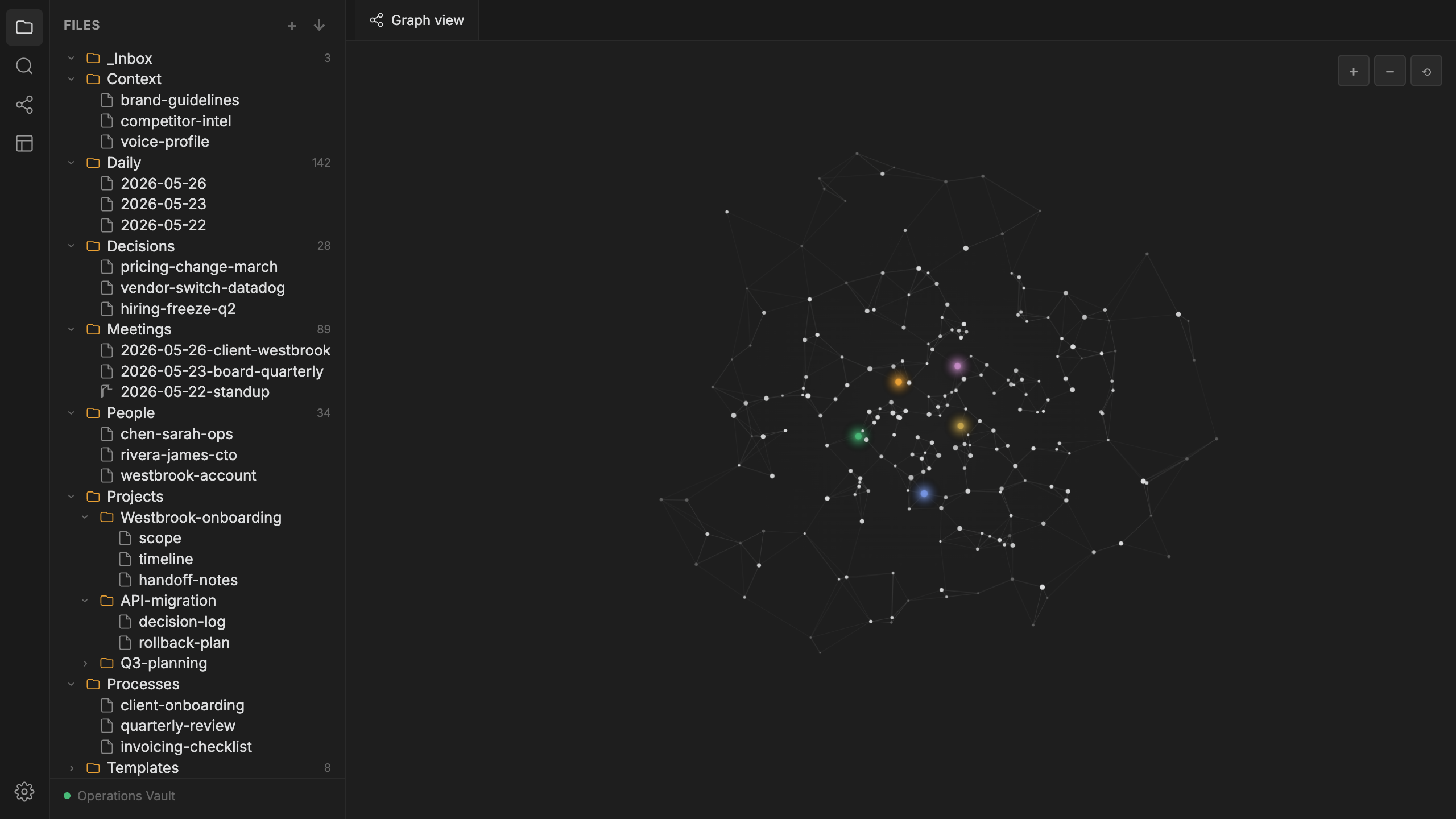
What I build
A system that remembers for you.
I build structured knowledge systems for teams and individuals. Each person captures what they read, decide, and produce. The system connects it: decisions link to their reasoning, project history stays findable, onboarding paths write themselves from accumulated context instead of from someone's memory.
The work is not recommending a tool. Most companies already have the raw material scattered across Slack, email, shared drives, and tribal knowledge. The work is designing the structure, migrating the context that matters, building the habits that keep it current, and wiring AI retrieval on top so the system gets smarter as people use it.
Knowledge routing
Every piece of information has one home. If a fact can live in two places, pick one and link from the other. Never duplicate authoritative content. The system enforces this with routing tables so a new contributor knows exactly where something goes without asking.
Cross-surface continuity
A conversation that starts in a meeting, continues in Slack, and produces a decision in email. All three are captured and connected. A fresh session on any device can pick up where the last one left off because the system maintains a "what just happened" anchor.
AI retrieval layer
The system is not a static archive. An AI layer reads it, indexes it, and surfaces relevant context when you need it. Ask "what did we decide about pricing in March" and get the answer with the reasoning attached. The more people contribute, the smarter it gets.
Autonomous maintenance
A nightly operator agent runs housekeeping: orphaned notes, broken links, stale items, frontmatter drift. Nobody has to remember to clean up. The system does it at 9pm whether you are paying attention or not.
What changes in practice
The meetings you stop having.
New hires find answers
Instead of booking "quick question" meetings, a new hire searches the vault and finds the decision, the reasoning, and the people involved. Ramp time drops from months to weeks.
Decisions stay found
Not just what was decided, but why, what was considered, and what changed. No more reversing a decision because nobody remembered the constraints that produced it.
Status meetings shrink
When context is written and searchable, the "catching everyone up" portion of the meeting goes away. The meeting starts at the decision point, not at the recap.
Institutional memory survives turnover
When someone leaves, the knowledge stays. Their decisions, their reasoning, their project context. The next person inherits a system, not a blank slate.
How I know this works
I use this system every day.
My own vault runs an autonomous operator that processes meeting notes, maintains project indexes, and keeps context fresh across sessions. When I sit down to work, I do not start from zero. Everything I have learned, decided, and discussed is already there. (The first version drifted. Orphaned notes, inconsistent logging, no reliable way for a fresh session to find context. I rebuilt it from scratch. That is how I know what goes wrong.)
Four different surfaces, desktop, CLI, web, mobile, all write to the same system and can pick up where any other left off. A nightly agent runs housekeeping. It gets healthier whether or not anyone is paying attention.
Three rules that override everything else: discoverability over cleverness, no orphans, one home per fact.
This is not theoretical. I built it because the first version drifted. Inconsistent logging, orphaned notes, no reliable way for a fresh session to pick up context. V2 fixes that with structure that enforces itself. That is the same discipline I bring to a team build.
What the engagement looks like
Architecture, migration, habits, retrieval.
I do not hand you a template and wish you luck. I build the system, then I teach you to run it, because the engagement is not finished until you can operate it without me.
If the answer is "ask Sarah," you do not have a knowledge system. You have Sarah.
Thirty minutes. You tell me where context gets lost, I tell you what the fix looks like.
Book a call